
Sex Offender Checks in Terrell County
The Texas Public Sex Offender Registry is Terrell County's official starting point. Texas DPS runs the free public system under Code of Criminal Procedure Chapter 62. Public searches need no account and filter by county, name, address, city, ZIP code, or map.
Registry results answer whether a person has a current public registration record and what DPS may display. They are not a full criminal history. A conviction may carry no present registration duty, and a listed offense may have occurred outside Terrell County. Read the offense jurisdiction, current registration authority, status, and verification data before drawing any conclusion. A map result also needs a profile-level identity check because a pin alone does not establish who lives at a location.
Terrell County Registry Authority
Texas divides local registration work by municipal status. A resident inside a municipality reports to that municipality's law-enforcement authority. A resident outside one reports to the county authority. The official Terrell County site identifies no incorporated city police department, and Sanderson is a Census-designated place rather than a city. That makes the Terrell County Sheriff the documented local contact for registration matters in Sanderson and elsewhere in the county.
Call the sheriff at 432-345-2525 for current appointment and location instructions. The county site does not publish a separate registration-unit address, counter schedule, or verification calendar, so none should be assumed. Local authorities maintain registrations, verify updates, notify schools when the law requires it, and forward information to DPS. The statewide profile remains the public search layer, while the sheriff handles the local reporting relationship and can receive a report of apparent noncompliance.
The DPS registration program overview explains that state and local roles work together. The captured program view below shows the official source for public access, registration, and notification rules.
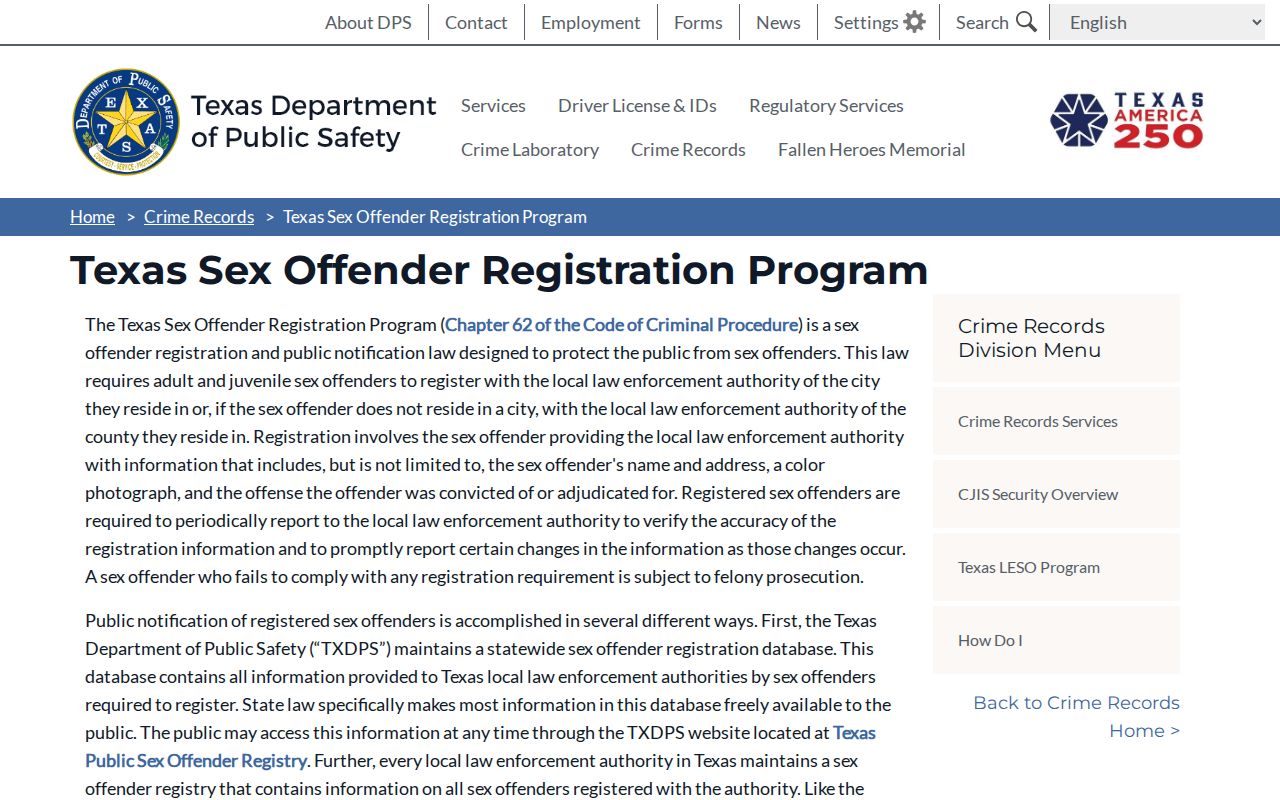
For Terrell County, that division of work means DPS supplies the public database while the sheriff performs the county-level registration function.
How to Search the Texas Public Sex Offender Registry
A Terrell County registry search works best when it moves from a broad county view to a careful profile check. The interface supports both identity and place-based searches. Use a full name when known, but do not rely on the name alone. Physical descriptors, an official photo, aliases, registration authority, and offense details help separate people who share a similar name. For location research, use the address or ZIP controls and then inspect both the map and the result list.
- Open the official DPS registry and choose the search mode that fits the known facts.
- Select Terrell County for a countywide view, or enter a name, address, city, or ZIP code to narrow the results.
- Review both list and map results. Open a profile only when its identifiers may match the person or place being checked.
- Read the complete profile, including status, risk label, registering authority, offense jurisdiction, verification data, and last update.
| Field Label | Type | Required | Notes |
|---|---|---|---|
| Name | Tab and form | Varies | Last name or an initial starts a name search; first and middle names narrow it. |
| Address | Address form | Address elements | Street, city, and ZIP controls support radius and map behavior. |
| County | Dropdown | No | Select Terrell for the county view. |
| City or ZIP Code | Text or dropdown | No | These fields narrow a location search. |
| Map | Interactive | No | Use geographic browsing, then verify details in the profile. |
| Search or Clear | Buttons | No | Submit the chosen filters or reset the form. |
The official Texas registry search form is shown in the sourced capture below.
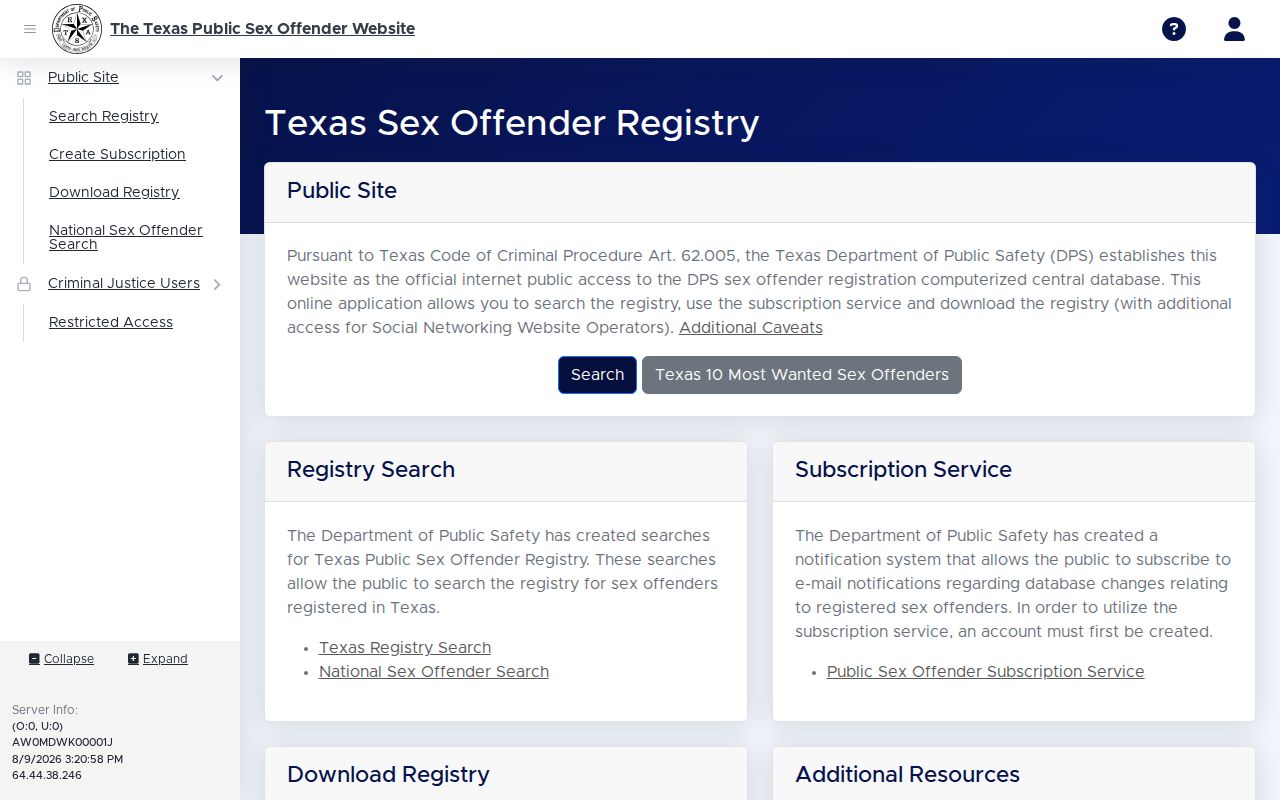
Its separate name and location controls let a Terrell County searcher start with the strongest known detail instead of guessing from an unverified third-party list.
Terrell County DPS Map Search
Terrell County covers a vast rural area, and a geographic search can be more useful than typing Sanderson into a city field. Since Sanderson is unincorporated, a city label does not define a separate police or registry jurisdiction. Search the county first, then test a precise address or ZIP code. Compare the map with the list because map placement can be approximate and a marker may represent a location description rather than the fact a searcher assumes.
If a pin appears wrong, do not confront the person at the location. Recheck the profile's primary and secondary residence fields, registration authority, last update, and verification information. A data question may go to DPS; an apparent reporting failure in Terrell County may be reported to the sheriff at 432-345-2525. The county's official phone and hours sheet is another county contact source, but callers should still confirm current registration instructions. Give the office the profile details and let the responsible agency assess compliance.
Inside a Registry Profile
A profile combines identity, location, registration, and offense fields that DPS is authorized to make public. Match several facts before deciding that a result concerns the intended person. The offense and jurisdiction fields matter as much as the current address because a Terrell County registration can arise from a conviction in another county or state. Status and verification data describe compliance records; they do not predict present conduct.
| Name and aliases | Legal name plus reported alternate names used to distinguish similar results. |
|---|---|
| Photo and descriptors | Official photograph, sex, race, age or date of birth, height, weight, hair and eye color, and possibly scars, marks, or tattoos. |
| Location | Primary or secondary residence, a location description, map, registration authority, and public school or higher-education information when applicable. |
| Offense record | Offense description, statute, jurisdiction, conviction date, victim age category when public, and punishment or release information. |
| Risk and status | Assigned Texas risk level, registration status, verification requirement, compliance data, and last update. |
| Other identifiers | State identification number, vehicle information, and other public details connected to the registration record. |
DPS withholds Social Security and driver-license numbers, telephone numbers, online identifiers, victim-identifying data, and additional DPS-only fields. Juvenile information ordered nonpublic is excluded. Those limits protect sensitive data while leaving enough official detail for identification and community awareness.
Terrell County Registry Data Limits
A registry profile is not a biography, a complete court file, or a statewide list of every conviction. Its public fields exist because Chapter 62 authorizes registration and notification. Nonpublic fields stay outside the search results even when DPS or the local authority keeps them for official work. A blank public field therefore does not prove the information is unknown to the agency.
For the source case, use the court named by the offense jurisdiction. For a wider county records picture, the broader Terrell County criminal history overview explains how sheriff, clerk, and DPS records differ. That distinction prevents a current compliance dataset from being mistaken for the originating prosecution file.
Note: Registry inclusion reflects a statutory reporting duty, not a finding about current conduct or a prediction of future behavior.
Texas Registration Levels and Requirements
Texas assigns low, moderate, or high risk levels through a risk assessment used for notification. These labels are not the federal SORNA Tier I, II, and III system. They also do not set registration length. The reportable conviction controls whether the duty commonly lasts ten years after release or discharge from community supervision, or for life. Check the precise offense under Code of Criminal Procedure Article 62.101 instead of inferring a term from the displayed risk label.
| Texas category | Public meaning | Registration duration | Visibility or notice |
|---|---|---|---|
| Low risk | Texas risk-assessment label | Not set by the risk label | Risk may appear on the public profile. |
| Moderate risk | Texas risk-assessment label | Not set by the risk label | Risk may appear on the public profile. |
| High risk | Texas risk-assessment label used in notification | Not set by the risk label | DPS may use added community notice when statutory conditions apply. |
| Ten-year duty | Duration tied to the reportable offense | Commonly ten years after release or supervision discharge | Public information remains subject to Chapter 62. |
| Lifetime duty | Duration for specified serious or repeat offenses | Lifetime | Public information remains subject to Chapter 62. |
The local authority handles required updates and verification, but the Terrell County site does not publish a frequency schedule. Use the profile's verification requirement and ask the sheriff about the current procedure. Do not convert a statewide risk term into a local check-in schedule that the official source does not state.
Terrell County Registry Duration
The clearest way to avoid a common reading error is to treat risk and duration as separate profile questions. First, note the low, moderate, or high risk label as a Texas notification factor. Next, read the qualifying offense and statute. Then consult Article 62.101 for the duration rule tied to that offense. A high label does not itself prove a lifetime duty, and a low label does not establish a ten-year term.
Registration clocks also require care. Research for Terrell County shows that a ten-year period commonly runs after release from a penal institution or discharge from community supervision, not simply from the conviction date shown on a profile. Specified serious or repeat offenses require lifetime registration. When duration affects a legal decision about one's own duty, rely on the current statute, court record, and responsible registration authority rather than a casual map reading.
Community Notification and Lawful Use
Texas makes registry information public for awareness and safety planning. Local authorities notify schools when required and report registration data to DPS. The state may mail community postcards when a high-risk registrant or a civilly committed sexually violent predator moves into a community. In rural Terrell County, that official notice can work alongside the public map, but neither one authorizes direct action against a registrant or household.
Use a profile to make calm safety choices, confirm official facts, and share a good-faith compliance concern with law enforcement. Do not threaten, harass, trespass, intimidate, or organize a confrontation. A profile's presence reflects a legal registration duty. It does not invite private enforcement.
Misuse is a crime: Texas Code of Criminal Procedure Article 62.005 makes prohibited misuse of central registry information an offense. Registry access never permits harassment, threats, intimidation, or trespass.
Terrell County Cross-State Registry Check
Terrell County sits in a border region, and an address or person may have a registration history outside Texas. The National Sex Offender Public Website, maintained as a federal search layer, brings participating state, territorial, and tribal public registries into one search. Use it after the Texas DPS search when movement across a state line is relevant. A negative national result does not replace a direct check of the Texas registry or the responsible local authority.
The national service and Texas DPS answer related but different search needs. DPS provides the Texas profile and state-specific fields. NSOPW expands geographic coverage. If the displays conflict, compare jurisdiction, status, last update, and identifiers, then contact the agency responsible for the source record.
The official NSOPW search appears in the sourced capture below.
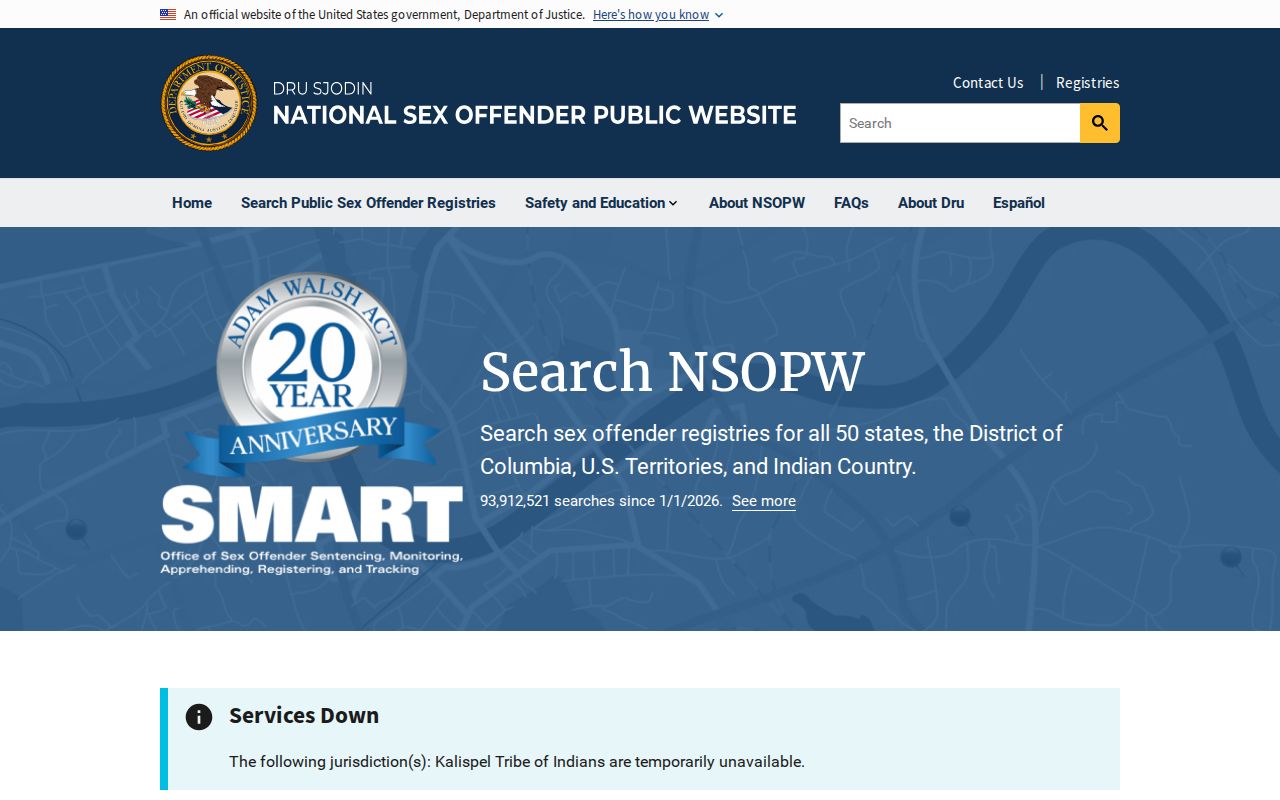
NSOPW expands coverage; Texas DPS remains the source for a current Terrell County profile.